There is a quiet, but important, shift underway in Zambia’s energy strategy.
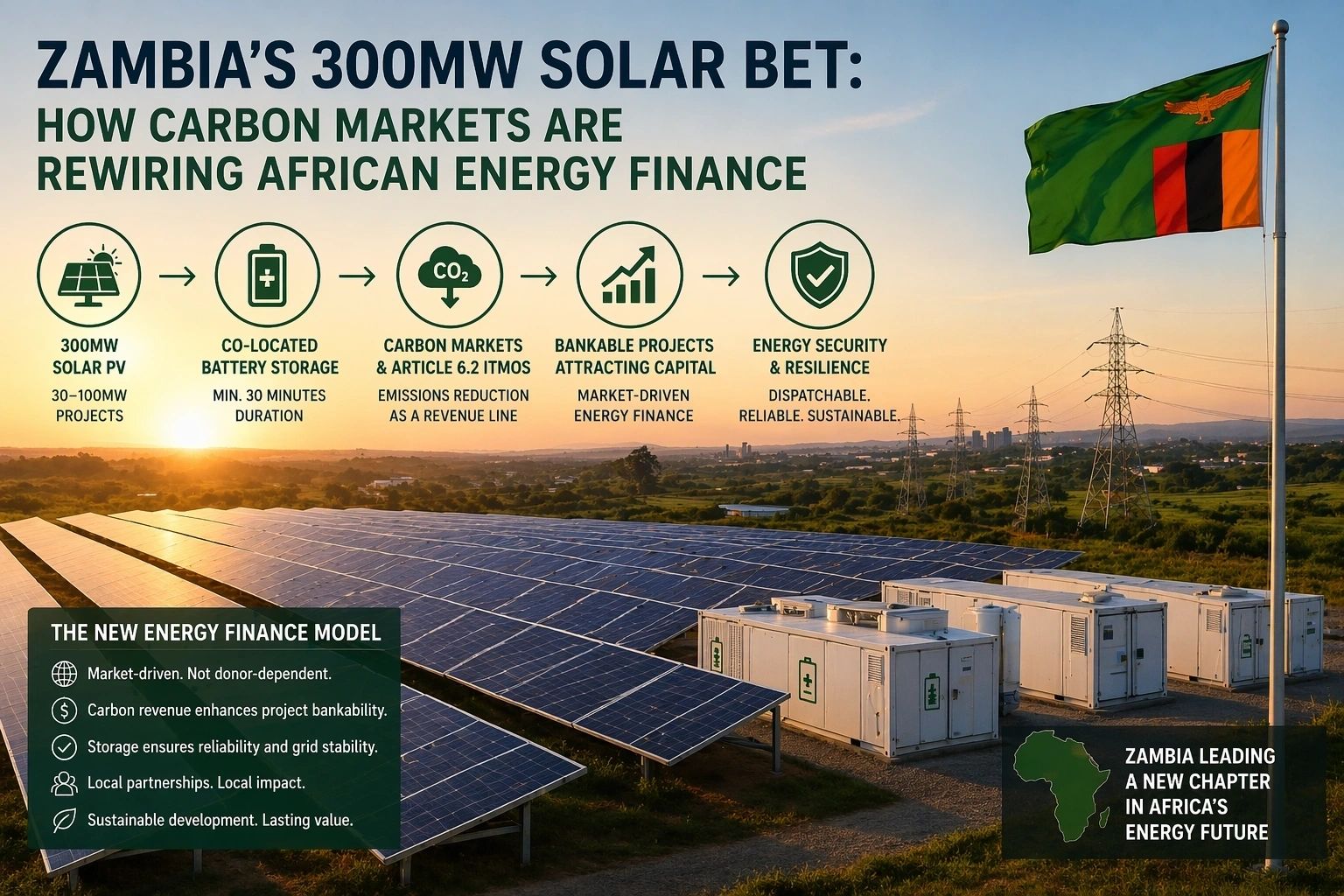
In April, the government opened a CFIP call for proposals for grid connected solar PV projects, targeting up to 300MW of capacity. Projects must fall within the 30 to 100MW range and include co located battery storage, with a minimum duration of 30 minutes, charged from the solar asset. That detail matters.
For years, large scale energy infrastructure across Africa has relied on development finance, sovereign backing, or multilaterals. Necessary, but often slow, complex, and limiting. What Zambia is signalling here is different, a move toward market driven, bankable infrastructure where Article 6.2 ITMOs, and the carbon linked feed in premium, sit at the centre of the financial model.
Put simply, if structured correctly, emissions reduction becomes a revenue line. That changes the conversation. It brings in a different class of investor, shortens the path to financial close, and helps close the gap between ambition and execution.
There is a second layer to this, storage. Requiring battery integration acknowledges a reality that can no longer be avoided. Solar alone is not sufficient. Dispatchability, grid stability, and reliability are now baseline requirements. The 30 minute requirement is modest, but deliberate, improving system quality without overburdening project economics.
Zambia, historically reliant on hydropower, has already felt the impact of climate variability. This is not simply a decarbonisation initiative. It is a move toward energy resilience. Credit should be given. The CFIP call shows coordination and intent within government that is pragmatic and commercially aware, and decisions that directly determine whether capital flows.
The next phase is more difficult. A tender is straightforward. Delivery is where most projects fail. A few factors will determine whether this becomes a genuine inflexion point, including clarity on ITMO structures, pricing, rights, authorisations and enforceability, alongside grid readiness, speed of execution, and strong local partnerships. If these align, Zambia will not simply be adding capacity, it will be setting a precedent.
From a project perspective, the direction of travel is encouraging. There is now a clear recognition that 30 to 100MW scale developments are not theoretical in markets such as Zambia. They are necessary, and increasingly viable when properly structured. The fundamentals have always been there, land, irradiation, and demand. What is changing is the financial framework.
The question is no longer whether these projects can be built. It is whether they can be structured well enough to attract capital and move at speed. That is where the real work now sits.
This is one to watch closely, not because of the headline number, but because of what sits behind it. If this model holds, it will not stop at 300MW.