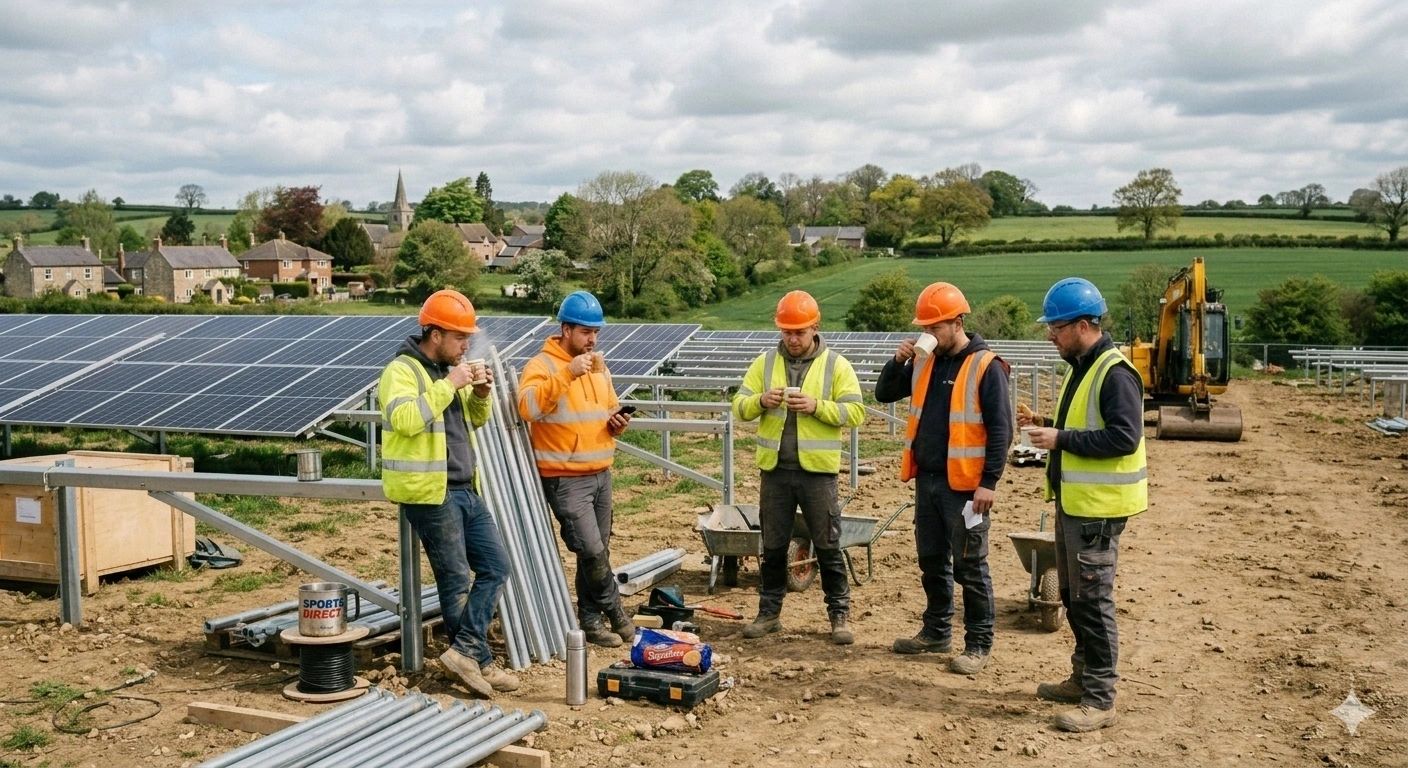
The UK has set out an ambitious path for solar energy, targeting around 70GW of capacity by 2035, with a major step-up required by 2030. On paper, it is credible. Technically, it is achievable. Financially, it is viable.
But politically and practically, the picture looks far less certain.
Recent planning decisions, such as the rejection of a relatively modest solar farm in Wiltshire, highlight a growing tension at the heart of the UK’s energy strategy. On the one hand, the government is calling for the rapid expansion of renewables. On the other hand, projects are being contested, delayed, or refused at local level.
This is not an isolated contradiction. It is becoming the pattern.
The uncomfortable truth is that the UK is trying to deliver a national energy transition through a system still largely designed for local consent. Each solar farm becomes a debate about landscape, heritage, proximity, and perception. Individually, those concerns are valid. Collectively, they form a structural barrier to scale.
And yet, the government continues to present the targets as achievable without fully explaining what it will take to get there.
Because the reality is simple. The land requirement for solar is not the real issue. The UK could meet its targets using a fraction of its total land area. The real constraints are planning friction, grid capacity, and public acceptance.
That is where the strategy begins to look incomplete.
There is increasing talk of rooftop solar, brownfield development, and faster grid connections. All sensible. All necessary. But progress remains uneven, and critically, the pace does not yet match the ambition.
At the same time, rural solar developments continue to face strong local opposition, particularly where communities feel surrounded or where projects are perceived to alter the character of the countryside. These are not fringe objections. They are shaping outcomes.
So the question becomes unavoidable.
Is the government genuinely aligned behind the scale of change required, or is it attempting to reach ambitious targets without fully confronting the political cost of achieving them?
Because delivering 70GW of solar is not a passive exercise. It requires clear choices: a significant expansion of rooftop solar, likely including mandates; faster, more decisive planning outcomes for strategically important projects; and meaningful reform of grid connection timelines.
A more honest conversation with the public about land use and trade-offs.
At present, the approach feels cautious. Incremental. Managed.
Some would say it risks looking like the government is pussy footing around the issue, signalling ambition while avoiding the harder conversations about what delivery actually entails.
And that carries its own risk.
Because if the public is not brought into that reality, if the scale, trade-offs, and consequences are not clearly communicated, then resistance will only grow. Not because people oppose clean energy, but because they feel decisions are happening around them rather than with them.
In that sense, the challenge is not just technical or financial. It is political and communicative.
Solar energy will play a central role in the UK’s future energy system. That much is clear. The question is whether the current approach is robust enough to deliver it at the required pace, or whether a more decisive, transparent, and coordinated strategy is now needed.
Because without that shift, the risk is not failure, but delay.
And in energy policy, delay is often just failure by another name.
So here is the question:
If the government truly intends to hit its solar targets, is it prepared to be honest with the country about what that will actually require, or will it continue to rely on ambition without fully confronting delivery?