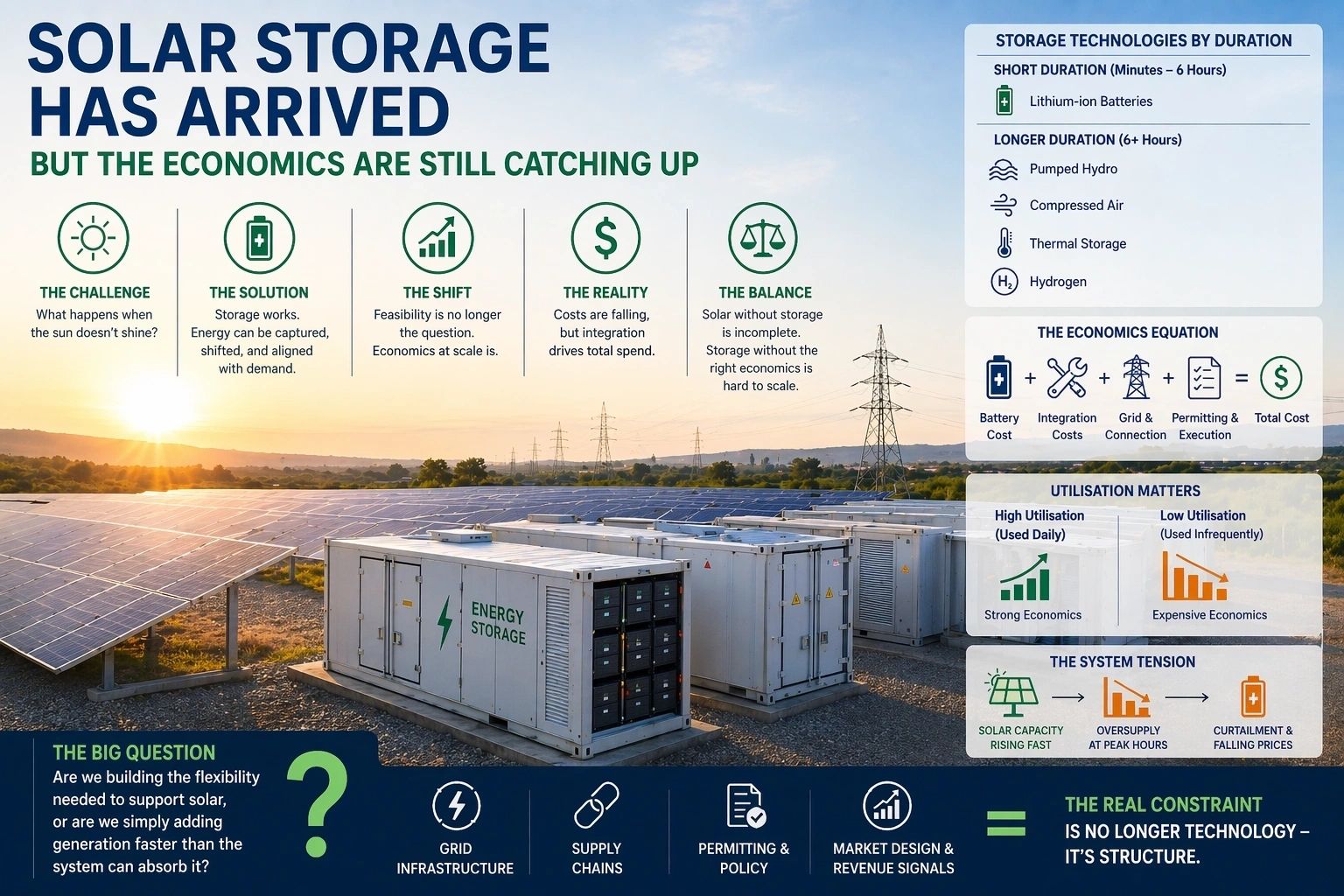
For years, the key challenge for solar was simple: what happens when the sun doesn’t shine? That question has now largely been answered. Storage works, from residential systems to grid-scale infrastructure. Solar energy can be captured, shifted, and aligned with demand.
The issue today is no longer feasibility, but economics at scale.
Short-duration storage, up to around six hours, is now well established and dominated by lithium-ion batteries. These systems are efficient, modular, and increasingly cost-effective. Beyond that, a wider mix of technologies emerges, including pumped hydro, compressed air, thermal storage, and hydrogen. Each has a role, but none is universally optimal. The reality is straightforward: storage solutions depend on duration and system need.
Costs have fallen sharply, but the battery itself is only part of the equation. Real-world deployment includes grid connections, land, cooling, safety, and permitting. These integration costs are now a significant share of total spend, meaning future reductions will depend less on manufacturing and more on execution.
Utilisation is equally critical. Batteries used daily can deliver strong economics. Those used infrequently become expensive. This is why short-duration storage is already viable, while long-duration solutions remain more uncertain, often relying on lower efficiency technologies simply because they are feasible at scale.
At the system level, a tension is emerging. Solar capacity is expanding rapidly, but storage is not keeping pace. The result is oversupply during peak hours, falling prices, and curtailment. Energy is being generated that the system cannot fully use.
This highlights the real constraint. Scaling storage is not just about cost. It depends on grid infrastructure, supply chains, permitting, and market design. In other words, the challenge is no longer technological, but structural.
Solar without storage is incomplete. Storage without the right economics is difficult to scale. The next phase of the energy transition will depend on whether we can align both.
So the question is this: are we building the flexibility needed to support solar, or are we simply adding generation faster than the system can absorb it?