A hard look at whether two-sided panels and single-axis trackers really boost yields enough to justify extra cost – vital for engineers and financiers.
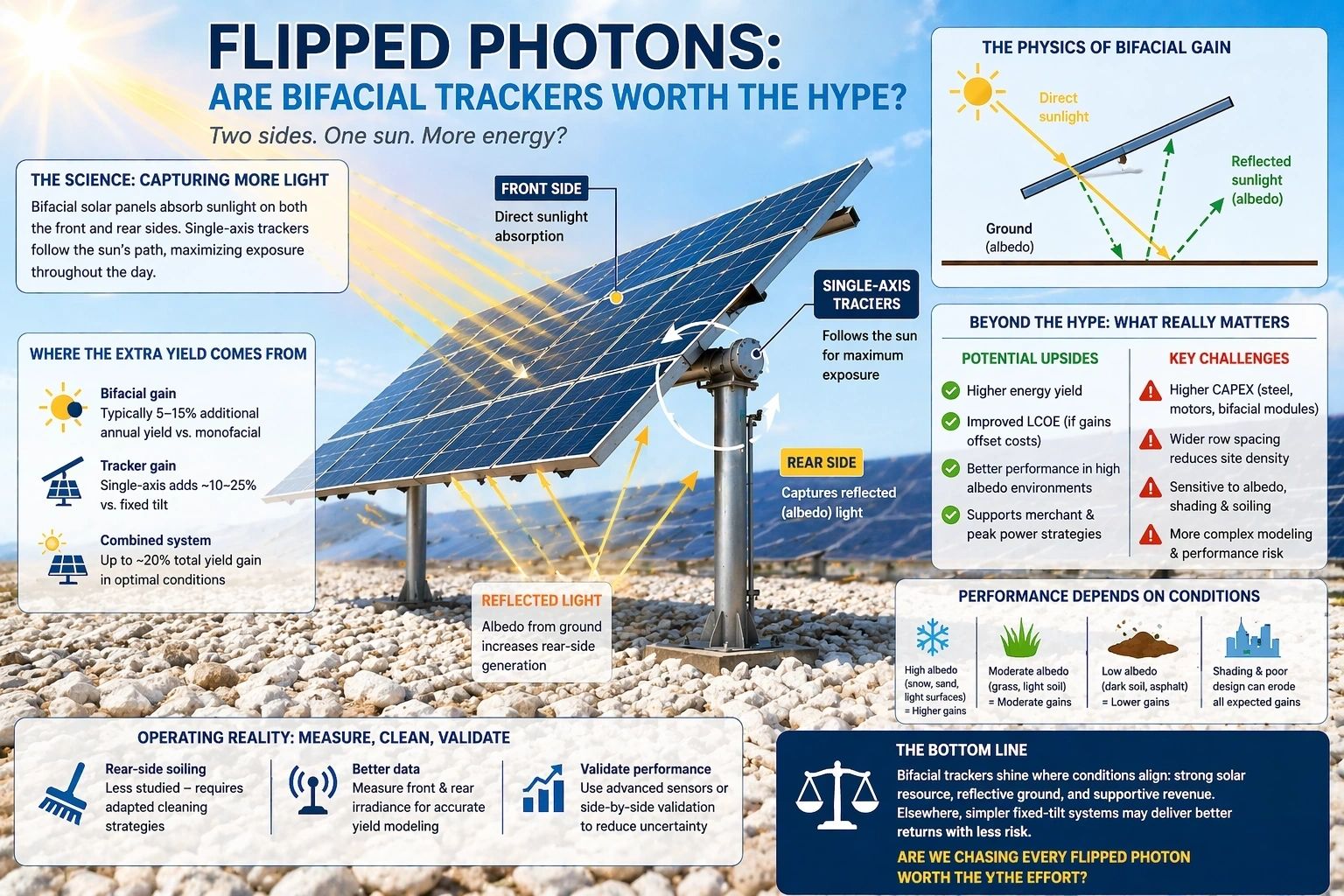
Ever since bifacial panels and sun-tracking mounts hit the market, utility projects have promoted double-sided gains and higher output. The idea is simple: capturing reflected light should increase generation. In practice, industry pilots show modest but meaningful gains – typically 5–15% additional annual yield versus monofacial panels. The “bifaciality factor” depends heavily on ground reflectivity – snow or light surfaces help, while darker terrain offers limited benefit. Single-axis trackers alone can add around 10–25% compared to fixed tilt. Combined, tracked bifacial systems can deliver up to ~20% total yield gains in optimal conditions.
Technology, however, is only part of the equation. Trackers and bifacial modules increase CAPEX and system complexity, adding significant costs in steel, motors, and modules. While LCOE can improve if yield gains outweigh these costs, results vary by site. Wider row spacing is also required to avoid rear shading, reducing site density. Financing depends on strong revenue conditions, such as peak pricing or merchant exposure. Performance is highly sensitive: lower albedo, shading, or poor design can quickly erode gains. In weaker solar environments, benefits diminish; in high-reflectivity regions, they can be significant.
Operationally, bifacial systems introduce additional challenges. Rear-side soiling remains under-researched and requires adapted cleaning strategies. Yield modelling becomes more complex, needing accurate measurement of both front and rear irradiance. Without this, output projections can be overstated. Developers increasingly rely on advanced sensors or side-by-side validation to reduce uncertainty.
Ultimately, bifacial trackers are most compelling where conditions align: strong solar resource, reflective ground, and supportive revenue structures. In such cases, they can enhance project value and bankability. Elsewhere, simpler fixed systems may still offer better overall returns.
Are we chasing every flipped photon worth the effort, or is simpler sometimes the smarter choice?