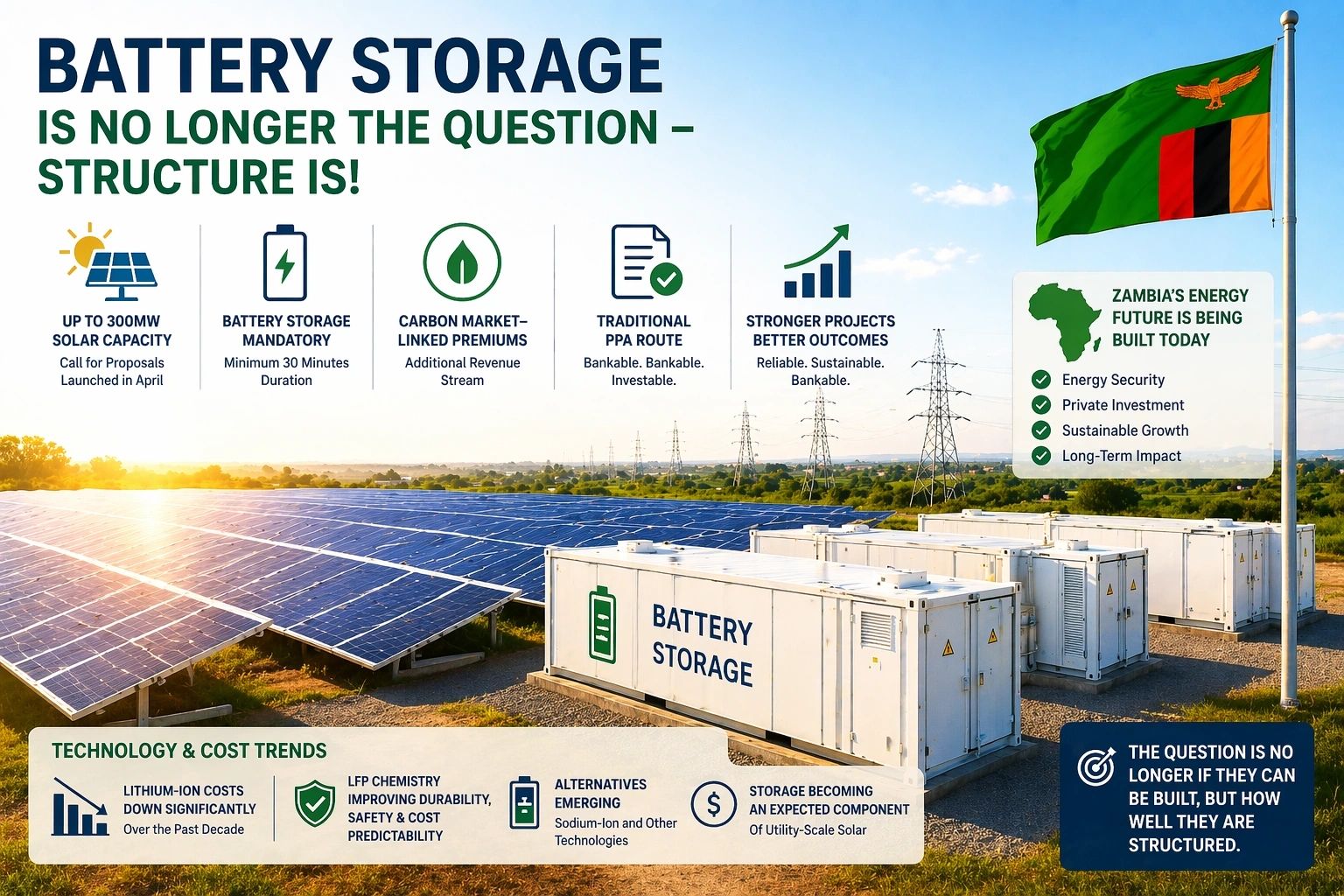
In April, the government launched a call for proposals to deliver up to 300MW of solar generation capacity, with a key addition: battery storage is mandatory, and projects are supported by carbon market-linked premiums alongside the traditional PPA route. That combination is not accidental.
For some time, battery storage sat just outside the core investment case. It was technically sound and strategically necessary, but commercially difficult to justify at scale. That position has now shifted. Costs have come down materially, performance has improved, and the technology is sufficiently proven. The constraint is no longer engineering. It is structure.
How the project is financed, how revenue is secured, and how risk is allocated are now the determining factors. This is where projects succeed or fail.
Zambia’s approach is, in that respect, measured. A minimum half-hour storage requirement is not overly ambitious, but it is directionally correct. It enhances project quality without forcing developers into the more complex economics of long duration storage at the outset. It also suggests a level of commercial awareness that is often missing in early-stage policy design.
The underlying technology story supports this shift. Lithium-ion costs have fallen significantly over the past decade, and the move toward LFP chemistry in stationary storage has improved durability, safety, and cost predictability. At the same time, alternatives such as sodium ion are beginning to emerge, offering additional flexibility in supply chains and pricing.
Looking ahead, this trend should continue. Not at the same pace as the last decade, but steadily enough that storage becomes an expected component of utility-scale solar, rather than an optional enhancement.
This brings the conversation back to projects. In markets such as Zambia, the fundamentals have never been the issue. Irradiation is strong, demand is clear, and land is available. What is changing is the expectation.
A 100MW project is no longer judged purely on generation capacity. It is judged on how well it integrates storage, how robustly it is structured, and how confidently it can move from concept to financial close. That is a higher bar, but a necessary one.
The question is no longer whether these projects can be built. It is whether they can be built properly.
Zambia’s latest tender suggests that the question is now being asked in the right way. The next phase will be delivery. If structure, speed, and execution align, this will not stop at 300MW. Those already operating at scale will recognise the shift.